
Last Updated June 2026
- Umbrella insurance can help cover your financial responsibility for injury or loss to someone else.
- It supplements the liability coverage provided by your home and auto policies.
- It can cover certain risks not included in standard policies, such as libel, slander, defamation or claims related to online posts or reviews.
- It’s an affordable way to protect your assets in case of a lawsuit.
- Umbrella coverage limits range from $1 million to $10 million.
Umbrella insurance provides an extra layer of financial protection if you’re found responsible for someone else’s injuries or property damage. Think of it as coverage that sits “on top of” existing liability limits on your home or auto policy. If those limits are reached in a serious claim or lawsuit, umbrella insurance can help cover the remaining costs, up to your policy limit.
Understanding umbrella insurance
One of the key differences between umbrella insurance and standard liability coverage is how and when it applies. Your home or auto policy includes liability protection, but those policies have set limits. In a major accident or legal claim, expenses like medical bills, legal fees or damages can add up quickly and exceed those limits. Umbrella insurance helps extend your coverage beyond those caps, which can be especially important if you have assets or savings you want to protect.
There are a few common misconceptions about umbrella insurance. Some people assume it’s only for the very wealthy, but in reality, it’s often a relatively affordable way to add significant coverage. Others think it replaces their existing liability policies; it doesn’t. Instead, it works alongside your home and auto policies, providing broader protection when you may need it most.
Many people considering an umbrella policy explore options like insurance bundling to potentially save money and time managing multiple policies.
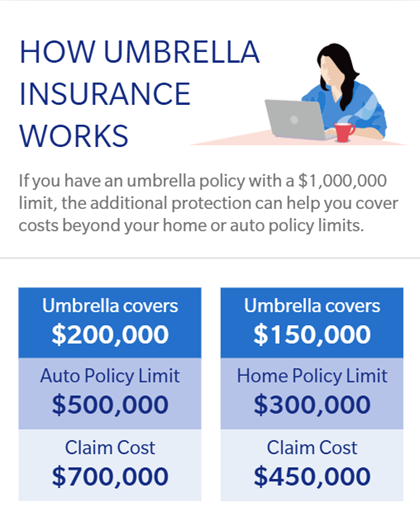
How does umbrella insurance work?
These scenarios show how liability coverage from your auto or home policy works first, and how an umbrella policy can help cover additional costs if a claim exceeds those limits.
Scenario: A car accident causes multiple injuries
Total damages: $500,000
Your auto policy limit: $500,000 (per accident)
Without umbrella, you pay: $0
In this case, your auto policy covers the full amount.
Scenario: A serious car accident exceeds your policy limits
Total damages: $750,000
Your auto policy limit: $500,000
Without umbrella, you pay: $250,000
With $1M umbrella, you pay: $0
Umbrella insurance can help cover the remaining $250,000.
Scenario: Someone is seriously injured at your home and you’re found responsible
Total damages: $750,000
Your home policy limit: $300,000
Without umbrella, you pay: $450,000
With $1M umbrella, you pay: $0
Umbrella insurance can help cover the remaining $450,000.
Scenario: You’re sued over a negative review or social media post and are found responsible for harming someone’s reputation
Total damages: $200,000
Your home or auto policy limit: May not cover this type of claim
Without umbrella, you pay: $200,000
With $1M umbrella, you pay: $0
Umbrella insurance may help cover certain claims like libel or slander that aren’t included in standard policies.
| Scenario | Underlying policy limit* | Total damages | What your auto or home policy may cover | What $1M umbrella policy may cover | Remaining out-of-pocket cost (with umbrella) |
|---|---|---|---|---|---|
| Auto accident with injuries | $250,000/$500,000 (auto liability) | $500,000 | $500,000 | $0 (umbrella not needed in this case) | $0 |
| Auto accident exceeding limits | $250,000/$500,000 (auto liability) | $750,000 | $500,000 | $250,000 | $0 |
| Injury to someone else (not car-related) | $300,000 (homeowners liability) | $750,000 | $300,000 | $450,000 | $0 |
| Injury to someone else (online slander or libel) | Underlying policy may not cover this type of claim | $200,000 | $0 | $200,000 | $0 |
Scenario
- Auto accident with injuries
- Underlying policy limit*: $250,000/$500,000 (auto liability)
- Total damages: $500,000
- What your auto or home policy may cover: $500,000
- What $1M umbrella policy may cover: $0 (umbrella not needed in this case)
- Remaining out-of-pocket cost (with umbrella): $0
- Auto accident exceeding limits
- Underlying policy limit*: $250,000/$500,000 (auto liability)
- Total damages: $750,000
- What your auto or home policy may cover: $500,000
- What $1M umbrella policy may cover: $250,000
- Remaining out-of-pocket cost (with umbrella): $0
- Injury to someone else (not car-related)
- Underlying policy limit*: $300,000 (homeowners liability)
- Total damages: $750,000
- What your auto or home policy may cover: $300,000
- What $1M umbrella policy may cover: $450,000
- Remaining out-of-pocket cost (with umbrella): $0
- Injury to someone else (online slander or libel)
- Underlying policy limit*: Underlying policy may not cover this type of claim
- Total damages: $200,000
- What your auto or home policy may cover: $0
- What $1M umbrella policy may cover: $200,000
- Remaining out-of-pocket cost (with umbrella): $0
Typical minimum underlying liability limits (e.g., $250,000/$500,000 auto, $300,000 homeowners) are commonly required by insurers before adding an umbrella policy; $1 million is a common starting limit for personal umbrella insurance policies. Source: Insurance Information Institute
What does umbrella insurance cover?
Umbrella insurance focuses on personal liability coverage, which means it can help cover costs if you’re held responsible for injuries to others or damage to their property. It doesn’t cover your own injuries or damage to your own belongings.
Umbrella insurance can help pay a range of costs if you’re found responsible for a covered claim, including:
- Legal defense costs, such as attorney fees, court costs and settlements or judgments
- Medical expenses for others, including hospital bills or ongoing care related to an injury
- Property damage costs, such as repairing or replacing someone else’s damaged property
- Lost wages or income claims, if someone is unable to work due to an injury you’re responsible for
- Personal liability claims, including situations that may not be covered by the underlying policy, such as libel, slander or defamation
- Certain landlord liability costs, if you own rental property and are found responsible for injury or damage
Who should consider umbrella insurance?
Umbrella insurance can be a practical option if you want an extra layer of financial protection beyond your home and auto policies — especially if you have more to lose in a large claim or lawsuit.
For example, you might consider umbrella insurance if you:
- Own a home or multiple properties
- Have significant savings, investments or other assets
- Have a teen or frequent drivers in your household
- Regularly host guests or entertain at your home
- Own items that could increase liability risk, like a pool, trampoline or Jet Ski®
Some activities can also increase your exposure to liability risks. The more interactions you have with others — whether on the road, online or in your community — the greater the chance that something unexpected could lead to a costly claim. While many situations may be covered by your home or auto policy, others — like certain claims related to what you say or share online — may not be covered at all. An umbrella policy can help in both cases: by extending your liability limits and, in some situations, providing broader protection.
How much umbrella insurance do I need?
Many policies start at $1 million in coverage, with higher limits available. A common approach is to choose a limit that at least matches — or exceeds — the total value of your assets. That way, you have a level of protection that aligns with what you could potentially lose in a worst-case scenario.
When deciding whether umbrella insurance makes sense for you, or what limit to choose, it’s helpful to understand that it typically works in conjunction with your existing policies and may require certain underlying coverage limits. Learn more about umbrella insurance requirements to help you understand what’s needed before adding this extra layer of protection.
The information contained in this page is provided for general informational purposes only. Read our editorial standards for Insurance Questions and other content. We make no representations or warranties of any kind, express or implied. This does not refer to any specific insurance policy and nothing herein is intended to replace or modify any terms in your actual policy.
Farmers may also provide information on topics that are not directly about insurance policies or coverage that we believe could be helpful to you. Information in such articles is not meant as professional advice, and any reliance you place on such information is therefore strictly at your own risk.
Related articles
What Is Personal Liability Insurance and What Does It Cover?
Personal liability coverage helps pay for medical bill and legal costs, up to the limit of your coverage, if an accident occurs in or out of your home.

Insuring Homes With Swimming Pools: What You Need to Know
Find out how homeowners insurance applies to swimming pools, what’s not covered, tips to reduce liability risks and costs, and how Farmers® can help.

How Much Homeowners Liability Coverage Should I Consider?
The amount of homeowners liability coverage you need should match your net worth. Learn how Farmers can help you determine how much coverage you need.
