
Last Updated June 2026
- Hazard insurance usually refers to dwelling coverage in a homeowners insurance policy.
- It helps pay for repairs when homes are damaged by covered events (also known as perils) listed in the policy, such as fire, storms or vandalism.
- Most mortgage lenders require hazard insurance coverage.
- Hazard (dwelling) coverage can help you protect the structure of your home but it does not include coverage for your personal belongings or liability risks.
Hazard insurance is a name mortgage lenders often use for dwelling coverage in a homeowners insurance policy. It can help you pay to repair or replace the structure of your house if it’s damaged by an unexpected event that’s covered by your policy, like a windstorm, hail or fire. A home insurance policy may call the events it covers perils, but mortgage lenders typically call them hazards.
What is hazard insurance, and how is it different from homeowners insurance?
When you buy a home, your mortgage lender typically requires you to buy hazard insurance, which is the term lenders use to describe the part of your home insurance policy that covers the physical structure of your home. If your house burns down or is hit by a tornado, the bank wants insurance to cover the damage because your home is the asset backing your loan.
In practical terms:
- Hazard insurance = dwelling coverage
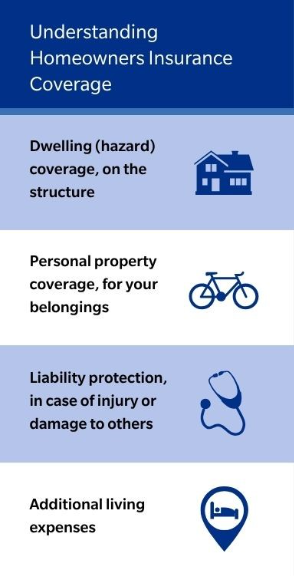
- Homeowners insurance = a policy that typically includes different types of coverages, such as:
- Dwelling (hazard) coverage, on the structure
- Personal property coverage, for your belongings
- Liability protection, in case of injury or damage to others
- Additional living expenses, if you have to move out temporarily because of covered damage
Click on graphic to download
Hazard insurance vs. homeowners insurance: What’s the difference?
| Feature | Hazard insurance | Homeowners insurance |
|---|---|---|
| What it is | A term lenders use for dwelling (structure) coverage | A policy that includes multiple types of coverage |
| Main purpose | Helps pay to repair or rebuild the physical structure of the home | Covers the structure plus belongings, liability and additional living expenses |
| Covers the structure (dwelling) | ✔ Yes | ✔ Yes |
| Covers other structures (shed, fence) | ✖ Not on its own | ✔ Usually included |
| Covers personal belongings | ✖ No | ✔ Yes |
| Covers liability (injuries/damage to others) | ✖ No | ✔ Yes |
| Covers additional living expenses | ✖ No | ✔ Yes |
| Is it a stand-alone policy? | ✖ Not typically — usually part of a homeowners policy | ✔ Yes — a multi-coverage policy (though dwelling-only policies also exist) |
What does hazard insurance cover?
Typically, hazard coverage in a homeowners insurance policy can help cover damage caused by a long list of events, including:
- Fire and smoke
- Windstorms and hail
- Lightning
- Explosions
- Some kinds of water damage
- Vandalism or theft-related damage
All policies are different, though, and it’s important to pay attention to which hazards are covered by the policy you choose.
What’s not covered by hazard insurance?
Hazard insurance typically excludes damage caused by:
- Floods, though separate hazard insurance for floods may be available through FEMA’s National Flood Insurance Program
- Earthquakes, though separate hazard insurance for earthquakes may be available
- Sewer backups
- Wear and tear
- Maintenance issues
- Intentional acts of damage
Standard dwelling (hazard) coverage may include certain risks but also impose limits in regions where there is a higher likelihood of catastrophic damage from that risk. Added coverage may be available.
For example, hazard insurance can provide coverage for damage from high winds. But in coastal Florida and other hurricane-vulnerable areas, policies may exclude the extreme winds of a major tropical storm. To have this coverage, homeowners would need separate wind insurance — sometimes called hurricane insurance. This may also be true in tornado-prone areas.
Keep in mind that hazard coverage on your home policy typically comes with a deductible that you choose. It’s the amount you must pay before your insurance begins to cover damage. And, of course, you’re only covered for hazard-related damage up to the policy limits that you choose. You can raise your limits by buying more insurance for other specific hazards, often called catastrophe insurance, or by adding umbrella insurance.
Do you need hazard insurance?
Yes, if you have a mortgage. Your lender almost certainly will require it. And if your policy lapses, your lender may:
- Purchase force-placed (or lender-placed) insurance on your behalf, which typically provides limited protection, covering the structure but not your belongings, liability or additional living expenses.
- Charge you for it (often at a higher cost).
If you don’t have a mortgage, you’re not legally required to have hazard insurance. But choosing to go without coverage means that if your home is damaged — for example, if wind rips shingles off your roof and rain pours through, ruining walls and floors — you would have to pay the full bill for repairs.
How much hazard insurance do you need?
Your hazard insurance coverage needs depend on many things, including the risks where you live, the type of home you live in and what it would cost to rebuild.
- Location. Risks vary by region. Coastal areas may have higher wind deductibles. Living in a wildfire-prone area (like California) can affect availability and pricing. Flood zones typically require separate flood insurance.
- Property type. The kind of home you own matters. Detached homes, condos, older properties and rental homes can each have different coverage needs, limits or policy types.
- Rebuild cost. Hazard insurance is based on the cost to repair or rebuild your home, not its market value. A home with ornate features or expensive materials, for example, would cost more to restore if damaged.
The information contained in this page is provided for general informational purposes only. Read our editorial standards for Insurance Questions and other content. We make no representations or warranties of any kind, express or implied. This does not refer to any specific insurance policy and nothing herein is intended to replace or modify any terms in your actual policy.
Farmers may also provide information on topics that are not directly about insurance policies or coverage that we believe could be helpful to you. Information in such articles is not meant as professional advice, and any reliance you place on such information is therefore strictly at your own risk.
Related articles
Does Homeowners Insurance Cover Water Damage?
Homeowners insurance may cover water damage if the cause was sudden. However, some types of water damage might not be covered. Learn what may or may not be covered.

Does Home Insurance Cover Natural Disasters?
Home Insurance policies do not cover natural disasters like Floods or Earthquakes, these types of disasters are covered on their own types of policies. Learn more.
